


I am titling this week’s note with this very interesting translation between English and Japanese. For many the Midterms are something to be very concerned and scared about. For others, the outcome is considered an opportunity. I believe that reading into last week’s voting results has repercussions that are far from fathomable at this point. Instead, I believe that it is far more important to have a foundational recognition of three important points:
- The direction of markets is far more dependent on earnings, interest rate levels, and the direction of the Fed than it is the knee-jerk reaction of an emotional action. It really doesn’t matter who was elected, it is far more important what effect these newly elected officials have on the current market and its directions.
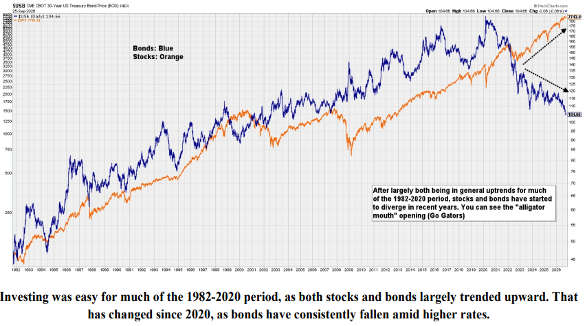
- Which places are the best to be concentrated in based on the relative strength analysis of overall markets. At present US equities are strongest, then commodities (as of November 5th they rose above international equities), and then international equities. Last is bonds as interest rates are clearly well seating in a defined uptrend which, as I explained last week, decreases the market value of fixed income instruments and therefore infers that there is little upside in this asset class. Again, here is the illustration of what is happening with bonds right now:
- Is the hysteria in the media all about the data centers really real? Of course nobody wants one in their back yard, but more are needed and American industry is resilient and creative. They will find a way, whether an abandoned shopping mall or vacant hotel. In the end, I believe that following the spread in high yield interest rates vs. riskless yields will tell us what that underlying expectations are from the financial markets.
Now back to our regularly scheduled program! I really need to give a bit more attention to the data center discussion. If we are to look at the “fears” about data centers (forget for a moment the environmental impact) the primary concern in the affect on the labor force and employment. Nonfarm payrolls increased 165,000 in October, easily beating the consensus expected gain of 70,000. Payroll gains for August and September were revised up by a total of 84,000, resulting in a net gain, including revisions, of 249,000.
The job market was hot in October, with plenty of good news to go around. Nonfarm payrolls rose 165,000, beating the forecast from every Economics Group on Bloomberg. In addition, payrolls were revised up by 84,000 for prior months, bringing the net gain to 249,000. Civilian employment, an alternative measure of jobs that includes small-business start-ups, rose 463,000 in October, while the labor force (people who are working or looking for work) gained 421,000. This helped push the headline unemployment rate down a tick to 4.1% from 4.2%, but it was really a rounding issue, with the precise rate barely budging to 4.141% from a prior 4.175%. More good news: average hourly earnings increased 0.4% in October, which outpaced consensus expectations for inflation for the month. Meanwhile, wages are up 3.1% from a year ago, which is lagging consumer price inflation but could help the Federal Reserve justify not raising short-term interest rates as much as the market now expects. In the past year, private payrolls are up 79,000 per month, defying fears of an AI-related job apocalypse, with manufacturing and construction combined up 16,000 in October and up 196,000 so far this year.
I want to give just a bit more color to the data center issue. Here is reality. The demand for data center and compute is greater than ever, and the supply is not nearly enough to meet the demand. Demand is accelerating. Today we see productivity is now up 3.6% in Q3 vs the historic average of 2.2%. That is due to AI. What it tells you is, AI is now being much more widely adopted, and that is just getting started. Unemployment claims were only 189,000, which is near a record low for 57 years. I can’t stress this enough. Companies are instituting the benefits of data centers and increasing their productivity and profitability dramatically and yet unemployment is at 57 year lows! That is the fact, not the media induced fear. Unemployment is at 4.2% which Iin near a record low. Manufacturing output is up 3.7%. Job openings are over 7 million and rising.
So, there is no negative impact form AI on jobs, and data centers will continue to get developed rapidly. They will simply go where they are wanted, the Dakotas, W Va, PA, IN, WY. Data center developers have finally learned they need to produce their own power and recycle water, or use other cooling methods, and pay the local town an up- front fee, and upfront cash to nearby homeowners. This is no different than other real estate development where you get NIMBE pushback. Good developers know what to do when there is resistance. Go elsewhere or pay the locals and agree to some mitigation. This is basic real estate development. As I have been saying for many months, the degree of misinformation in Wall St and the media is extraordinary.
In the New York Times over the weekend, they mentioned a woman who was protesting that a datacenter was being built by her. It just so happened that it was going to be a repurposing of a vacant shopping center and would be completely self-contained not just generating its own electricity but also recycling its cooling system water for reuse and having no negative effect to the environment. Think about the amount of jobs this will create for construction and management, and the amount of income generated to the local tax base.
The bottom line of all of this is that the whole data center business is still just getting going worldwide. All of them need the equipment a lot of which is made in the US by the suppliers I have been mentioning. The demand for compute is growing faster than anything in history because there is no limit to the demand for information, and the more information is immediately accessible on smart phones, laptops or major computers, or other devices and machines, the more demand grows even faster. It is accelerating as more enterprises and individuals learn how to use AI. That is what much of Wall St does not seem to understand. Demand for compute has zero to do with demand for railroads in the 1800’s, or for fiber, or anything in history because it is already demanded across the world, and there are 7 Billion smartphones already in use, and all demand compute. And that leaves out all the computers and other devices of all types that are connected to the internet. They all need a data center.
Now let’s take a moment and go back to the markets. If we think about number 2 above, US equities are the current major asset leader. Within the US markets, monies can be subdivided into value and growth. Growth is the one most in focus and is most clearly evidenced by the NASDAQ 100 index, better known as the QQQ. The other is the large-cap value index which I will touch on in a moment.
To drill down to last week’s market action, I wanted to capture the analysis by Thomas Lee of FundStrat Direct. According to Tom:
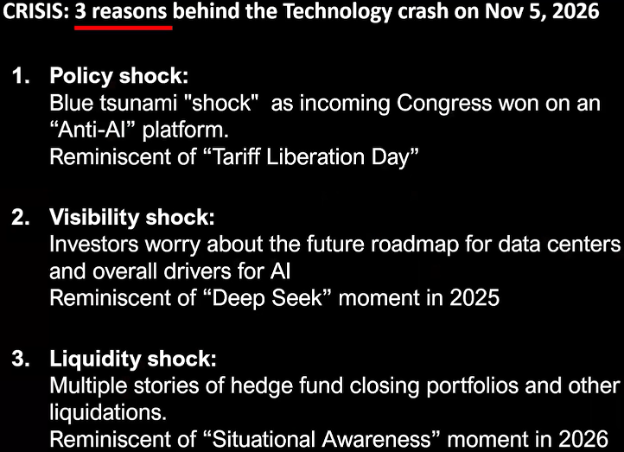
The first two are quite evident and have been brought out clearly by the media. The third one not so much. In looking at the large amount of volatility many hedge funds leverage up their bets and occasionally get out over their skis and end up blowing themselves up. This time it was:
- Axebrook
- Walleye
- Engineers Gate
- Lone Pine
- Millennium internal pods
- Verition pods
- Samlyn
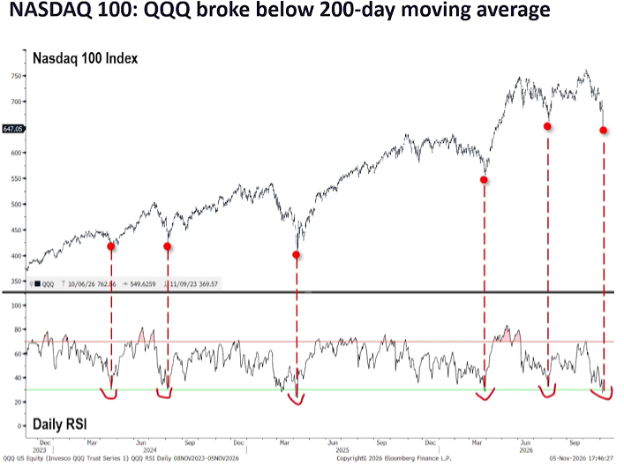
I am not very familiar with any of these but if you are bored you can look them up! If we boil down a bit further in most recent history, it can be seen that the most recent flash declines ended up coming to an end relatively quickly. Going back to the beginning of the uptrend investors have been enjoying since the Fed’s last interest rate hiking cycle of 2022, here is what the QQQ has looked like. If we simply look at what it has done subsequent to declines like what was experienced last week, it can be seen what might be expected next- given no changes in interest rates, Fed actions, and corporate earnings:
A Halloween Treat for Value Bulls
For years, ever since the recovery from the lows of the S&P 500 in 2022, ever since the end of the tightening cycle and equity recovery, growth companies have been the leaders. Although this has continued to be the case in 2026, there are signs that value may be getting its day in the sun. Many times, this is a short-term blip that can occur due to oversold levels or some other exogenous event. This time it is appearing that the recovery in value may be a bit stickier. As can be seen below, the S&P 500 has been on a steady advance with short bouts of pullback before the continuation of the advance. Below the S&P chart is a picture of how the value portion of the more broad Russell 1000 index has done relative to the growth components. From the end of 2022 until the beginning of the fourth quarter of last year growth continued its relative strength advance. The spike at the bottom represents when value began to take a more active role in the advance of the S&P and actually began to compete with the performance of their growth brethren. The dotted line represents a sort of “line in sand” where value had been attempting to have a longer lasting advance yet couldn’t quite muster the internal strength to continue. As can be seen where the arrow is, after 5 attempts to complete its rounding bottom value finally has broken out to the upside and appears to be providing the breadth expansion the market needs to continue moving higher.
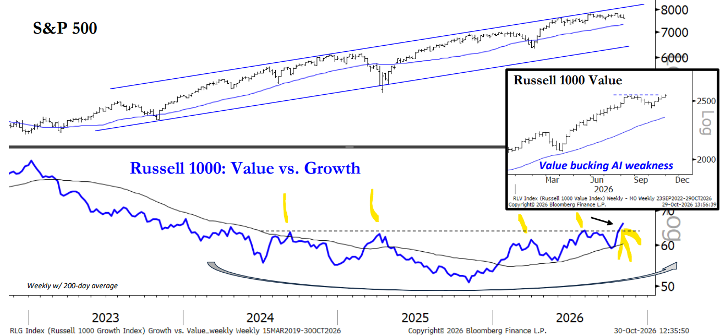
Will this end up being another pause to refresh for the growth segment or the beginning of something longer lasting is yet to be seen, but I believe this does deserve investor attention and respect unless value either falls back down or growth reaccelerates.
In closing, more importantly, we believe the AI structural story is intact, and that the continued strength of earnings in leading companies in this space should continue and add strength to the value contingent companies I have shown above. The ‘blue tsunami’ while interrupting the narrative, in our view, is not an AI killer. Let look at the 4 key elements to AI:
- demand –> corporate and discoveries
- supply –> supply of components and infrastructure globally
- speed –> speed of deployment
- net present value –> the 25-yr net present value of future cash flows
On demand, AI demand remains strong driven by continued frontier lab innovation and users seeing productivity. US corporations are seeing benefits and productivity from AI. And they should continue to increase their use of AI. On supply, AI infrastructure remains a tight market for semis, memory, power, infrastructure. These moratoriums are turning a tight market into arguably a tighter market but at a different dimension and point in the supply chain.
On deployment speed, supply growth was already constrained by shortage of supply, local permitting and long lead times. But US and AI companies should adapt as US industry has in the past when presented with what was thought to be an insurmountable hurdle. They will foremost have to make inroads with incoming Democratic leaders. They will have to be innovative, and an example is repurposing obsolete telephone buildings, shopping centers, and vacant high rises. And they will most likely build in AI friendly states and nations.
So, the impact on net present value of the AI opportunity, in my view, is largely unchanged. There may be some change in speed in the short term. But the upside skew on AI is so large. Lastly, let’s not forget the US corporates have proven very adaptable and have turned past crisis into profitable opportunities. Here is a short list of recent shocks:
- COVID-19
- 2022 Fed hikes
- Tariff Liberation Day
- Iran War
- now the Blue Tsunami
I will be taking a hiatus this next week, but expect my next commentary on Tuesday November 24th, something to enjoy with your Thanksgiving turkey.
-Ken South, Tower 68 Financial Advisors, Newport Beach
Important Disclosures:
The opinions voiced in this material are for general information only and are not intended to provide specific advice or recommendations for any individual. To determine which investment(s) may be appropriate for you, consult your financial professional prior to investing. All performance referenced is historical and is no guarantee of future results. All indices are unmanaged and cannot be invested into directly.
Investing involves risks including possible loss of principal. No strategy assures success or protects against loss. There is no guarantee that a diversified portfolio will enhance overall returns or outperform a non-diversified portfolio. Diversification does not protect against market risk.
The Standard & Poor's 500 Index is a capitalization weighted index of 500 stocks designed to measure performance of the broad domestic economy through changes in the aggregate market value of 500 stocks representing all major industries. The S&P 500 is a stock market index tracking the stock performance of 500 of the largest companies listed on stock exchanges in the United States. Indexes are unmanaged and cannot be invested in directly.
The Dow Jones Industrial Average is comprised of 30 stocks that are major factors in their industries and widely held by individuals and institutional investors.
The Nasdaq-100 is a large-cap growth index. It includes 100 of the largest domestic and international non-financial companies listed on the Nasdaq Stock Market based on market capitalization.
The NASDAQ Composite Index measures all NASDAQ domestic and non-U.S. based common stocks listed on The NASDAQ Stock Market. The market value, the last sale price multiplied by total shares outstanding, is calculated throughout the trading day, and is related to the total value of the Index. Indexes are unmanaged and cannot be invested in directly.
The Russell 2000 Index is an unmanaged index generally representative of the 2,000 smallest companies in the Russell 3000 index, which represents approximately 10% of the total market capitalization of the Russell 3000 Index.
Data sourced from Bloomberg (2025).
Stock investing includes risks, including fluctuating prices and loss of principal. No strategy assures success or protects against loss. There is no guarantee that a diversified portfolio will enhance overall returns or outperform a non-diversified portfolio. Diversification does not protect against market risk.
Bonds are subject to market and interest rate risk if sold prior to maturity. Bond values will decline as interest rates rise. Bonds are subject to availability, change in price, call features and credit risk.
Government bonds are guaranteed by the US government as to the timely payment of principal and interest and, if held to maturity, offer a fixed rate of return and fixed principal value.
Bond yields are subject to change. Certain call or special redemption features may exist which could impact yield.
International investing involves special risks such as currency fluctuation and political instability and may not be suitable for all investors.
Alternative investments may not be suitable for all investors and should be considered as an investment for the risk capital portion of the investor’s portfolio. The strategies employed in the management of alternative investments may accelerate the velocity of potential losses.
This information is not intended to be a substitute for specific individualized tax advice. We suggest that you discuss your specific tax issues with a qualified tax advisor.
The economic forecasts set forth in this material may not develop as predicted and there can be no guarantee that strategies promoted will be successful.
The financial professionals with Tower 68 Financial Advisors are registered with, and securities and advisory services are offered through LPL Financial, a registered investment advisor. Member FINRA/SIPC.
LPL Tracking #1206892