


With the month and quarter ending Tuesday, the stock market has obviously withstood the "September Scaries" that I have been focusing on coming into the month. Now, stocks enter what has historically been the best three-month period of the year. Moreover, as Bespoke Investment Group notes,the market tends to do even better in the fourth quarter when it is up through the first three quarters of the year(which shouldn't come as a huge surprise). As always, seasonality and historical tendencies guarantee nothing and should only be used as a guide (see lack of downside in September), though history does seem to offer yet another tailwind for the market through the rest of 2025.
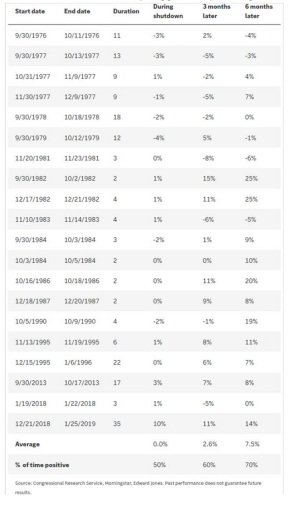
Tuesday night, a government shutdown appears to be the next possible stumbling block for the market, though historically, these shutdowns have been of questionable importance to stocks. According to Edward Jones research, there have been 20 shutdowns since 1976. The media act like the nation will cease to function, turns out, it functions just fine. They have lasted an average of 9 days and produced an average return of...0.0% in the S&P 500 – literally no change. The worst performance during a shutdown was only -4%, andlooking out 6 months after the shutdowns, the S&P has been up an average of 7.5%, better than the typical returns over half a year. The last shutdown back in 2018 was the longest in history at 35 days, and the S&P actually rallied 10% during that time. With the stock market seemingly "overdue" for a pullback, few would be surprised if it did so to coincide with a shutdown. Yet, history suggests any damage will be fleeting. See the table below of all 20 shutdowns. I include this for those history buffs that are entertained by tying the date to something they remember:
At the risk of upsetting both sides of the aisle, I just don't think politics is nearly as important to the financial markets as many believe it to be. While that seems to be all that some think about these days, viewing everything through a partisan lens, the market is largely unbothered by 99% of the goings on in Washington.
Yes, obviously policies can have some direct impact on occasion, such as when destabilizing tariffs are first announced and then walked back, but for the most part, most of what occurs in D.C. just does not significantly impact the day-to-day operations of companies or materially alter their future earnings. The bull market in stocks since 2009 has endured through three different presidents and a mix of leadership from both parties. It has not mattered. Going back further, the impacts of politics seems to be even less of an issue. According to NASDAQ.com, from 1957 when the modern S&P 500 was created through July 3, 2024, when their study was performed, the median compound annual growth rate (CAGR) for the S&P was 10.2% during Republican terms and 9.3% under Democrat terms.
Truthfully, there has been little difference under the two administrations and shutting down the government has not historically shut down the stock market. Don't let politics get in the way of your portfolio.
- Ken South, Tower 68 Financial Advisors, Newport Beach
-
Get Ken's Weekly Market Commentary Delivered To Your Inbox!
Important Disclosures:
The opinions voiced in this material are for general information only and are not intended to provide specific advice or recommendations for any individual. To determine which investment(s) may be appropriate for you, consult your financial professional prior to investing. All performance referenced is historical and is no guarantee of future results. All indices are unmanaged and cannot be invested into directly.
All information is believed to be from reliable sources; however LPL Financial makes no representation as to its completeness or accuracy.
Investing involves risks including possible loss of principal.
The Standard & Poor's 500 Index is a capitalization weighted index of 500 stocks designed to measure performance of the broad domestic economy through changes in the aggregate market value of 500 stocks representing all major industries. The S&P 500 is a stock market index tracking the stock performance of 500 of the largest companies listed on stock exchanges in the United States. Indexes are unmanaged and cannot be invested in directly.
The Dow Jones Industrial Average is comprised of 30 stocks that are major factors in their industries and widely held by individuals and institutional investors.
The Nasdaq-100 is a large-cap growth index. It includes 100 of the largest domestic and international non-financial companies listed on the Nasdaq Stock Market based on market capitalization.
The Russell 2000 Index is an unmanaged index generally representative of the 2,000 smallest companies in the Russell 3000 index, which represents approximately 10% of the total market capitalization of the Russell 3000 Index.
Data sourced from Bloomberg (2025).
Stock investing includes risks, including fluctuating prices and loss of principal.
Bonds are subject to market and interest rate risk if sold prior to maturity. Bond values will decline as interest rates rise. Bonds are subject to availability, change in price, call features and credit risk.
Government bonds are guaranteed by the US government as to the timely payment of principal and interest and, if held to maturity, offer a fixed rate of return and fixed principal value.
Bond yields are subject to change. Certain call or special redemption features may exist which could impact yield.
International investing involves special risks such as currency fluctuation and political instability and may not be suitable for all investors.
Alternative investments may not be suitable for all investors and should be considered as an investment for the risk capital portion of the investor’s portfolio. The strategies employed in the management of alternative investments may accelerate the velocity of potential losses.
This information is not intended to be a substitute for specific individualized tax advice. We suggest that you discuss your specific tax issues with a qualified tax advisor.
LPL Tracking #805829